You're Paying $80 for Olive Oil in a Fancy Bottle — Here's the Proof
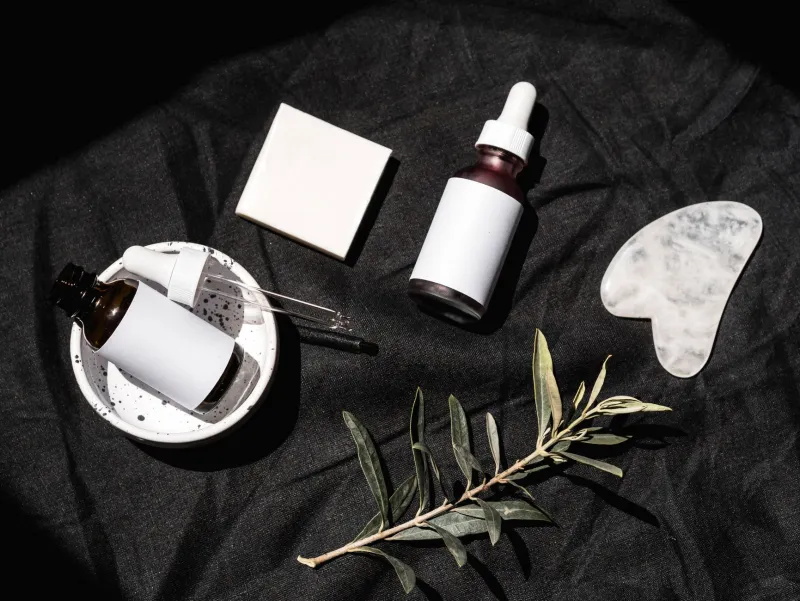
Let's be honest about something that the beauty industry really doesn't want you to figure out: a huge chunk of those premium facial oils lining the shelves at Sephora and Nordstrom are, at their core, olive oil. Dressed up, renamed, cold-processed with a catchy trademarked method, and packaged in a matte-black dropper bottle that costs more to produce than the liquid inside it.
We're not trying to be dramatic. We're trying to save you about $500 a year.
At Zeytin Beauty Lounge, we've built our entire philosophy around authentic Turkish zeytin oil — zeytin being the Turkish word for olive — and we've watched clients come through our doors carrying luxury oil serums that, once we started comparing labels, left us genuinely frustrated on their behalf. So we did a deep dive. We pulled ingredient lists, talked to a Turkish beauty chemist with over a decade of formulation experience, and ran a casual but eye-opening blind smell test with a handful of willing volunteers. Here's what we found.
The Label Game Is Rigged Against You
Flip over almost any high-end facial oil — the kind that costs $65 to $120 for a 1-oz bottle — and scan the ingredient list. You'll often find Olea Europaea (Fruit Oil) sitting right at the top. That's the scientific name for olive oil. Sometimes it's listed as Olea Europaea Leaf Extract or Fruit Extract, which sounds more sophisticated but is still derived from the same tree that produces the olive oil in your kitchen cabinet.
The brands aren't technically lying. They're just leaning hard on marketing language — words like "cold-pressed," "squalene-rich," "Aegean-sourced," or "small-batch artisanal" — to create distance between what you think you're buying and what you're actually getting. The difference in quality between a well-sourced, authentic Turkish zeytin oil and some of these luxury products is, according to formulation chemist Elif Sarıkaya (who trained in Istanbul and now consults for independent beauty brands in the US), often negligible from a skin-benefit standpoint.
"The molecules don't care what the bottle looks like," Sarıkaya told us. "Oleic acid is oleic acid. Squalene is squalene. If the sourcing and processing are comparable, you're paying for branding, not biology."
What the Blind Smell Test Actually Revealed
We gathered five products: a $90 luxury facial oil from a well-known prestige brand, a $45 "clean beauty" oil from a popular wellness label, a $32 mid-range option from a natural skincare company, a bottle of authentic Turkish zeytin oil sourced directly from an Aegean producer, and a standard grocery-store extra-virgin olive oil as a control.
Seven testers smelled each product without seeing the labels. The results? Most testers couldn't reliably distinguish the $90 luxury oil from the authentic Turkish zeytin oil — or, in three cases, from the grocery-store olive oil. The "clean beauty" option had added fragrance that made it immediately identifiable, but not in a way that suggested superior quality. Several testers actually preferred the scent profile of the authentic zeytin oil, describing it as "fresher" and "greener" compared to the luxury option, which one tester called "kind of processed-smelling."
Not a scientific study, obviously. But still pretty telling.
So What Actually Makes Zeytin Oil Effective?
Here's where it gets genuinely interesting, because authentic Turkish zeytin oil is legitimately excellent for skin and hair — just not for the reasons luxury brands would have you believe.
Sarıkaya walked us through the actual chemistry. High-quality zeytin oil is rich in oleic acid (which penetrates the skin barrier and deeply moisturizes), squalene (a naturally occurring compound your skin already produces that decreases with age), vitamin E (an antioxidant that helps neutralize free radical damage), and polyphenols (plant compounds with anti-inflammatory properties). The key variables that determine quality aren't the bottle or the brand story — they're the olive variety, the harvest timing, the pressing method, and how quickly the oil is processed after harvest.
Turkish olive-growing regions — particularly areas around the Aegean coast — have spent centuries refining these variables. The olives are often harvested earlier (when polyphenol content is at its peak), cold-pressed within hours of harvest, and stored in ways that minimize oxidation. That's the real differentiator. Not a $40 glass bottle.
"When I look at some of these prestige oils," Sarıkaya said, "I see olive oil that's been processed adequately but not exceptionally, combined with maybe a few drops of a trendier oil like marula or rosehip for marketing purposes, and then sold at a 1,000% markup. Meanwhile, a traditional Turkish zeytin oil from a quality producer is doing more for your skin at a fraction of the cost."
The Math That Should Make You Angry
Let's talk numbers, because this is where it really stings. A 1-oz bottle of a popular luxury facial oil retails for around $88. At typical usage (5-7 drops per application, once or twice daily), you're going through roughly one bottle every 6-8 weeks. That's potentially $500 to $700 a year — just on facial oil.
A 4-oz bottle of authentic, high-quality Turkish zeytin oil from a reputable source? Typically $18 to $35, depending on the producer and where you're buying it. At the same usage rate, you're spending maybe $80 to $120 annually. And you're getting a product that, based on the actual active compounds, performs comparably or better.
The difference — that $380 to $580 gap — is going directly into packaging design, influencer partnerships, and retail markup. Not into your skin.
How to Spot the Real Thing
If you want to make the switch to authentic zeytin oil (and honestly, we think you should), here's what to look for. Seek out oils that list the specific olive variety and region of origin — Gemlik, Memecik, and Ayvalık are all well-regarded Turkish cultivars. Look for early-harvest or "erken hasat" designations, which indicate higher polyphenol content. The oil should have a slightly peppery finish when you rub it between your fingers and a fresh, grassy scent — not a flat or rancid smell. And it should come in dark glass to protect against light oxidation, not just for aesthetics.
At Zeytin Beauty Lounge, we use and recommend oils that meet these standards — and we've seen the results on our clients' skin and hair firsthand. The glow is real. The softness is real. The $500 annual savings? Also very real.
The Bottom Line
The luxury beauty industry is exceptionally good at selling you a story. And to be fair, some of those stories are beautifully told. But when the story costs you $500 a year and the product inside the bottle is fundamentally the same as something that's been growing on Turkish hillsides for thousands of years — well, that's a story worth interrupting.
Authentic zeytin oil isn't a budget compromise. It's the original. Everything else is just a repackage.